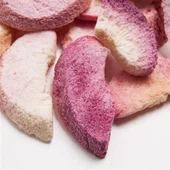
Introduction: The Quest for Perfect Preservation
Raspberries are nature's delicate jewels-bursting with vibrant color, complex sweet-tart flavors, and a powerhouse of antioxidants like Vitamin C and anthocyanins. However, their high water content (approx. 85-87%) and fragile structure make them notoriously difficult to preserve. Traditional methods like hot-air drying often result in shriveled, browned, and nutrient-depleted fruit that bears little resemblance to the fresh berry.


The Core Mechanism: Sublimation, Not Evaporation
To understand why freeze drying is superior, one must first understand the physics of water removal.
Traditional Drying (The Problem)
In conventional hot-air drying or sun-drying, heat is applied to evaporate liquid water into vapor.
The Damage: As liquid water moves from the center of the cell to the surface to evaporate, it drags dissolved sugars, acids, and pigments with it. This causes case hardening (a tough outer shell), shrinkage, and the collapse of the cellular structure.
The Heat Factor: High temperatures degrade heat-sensitive vitamins (like Vitamin C) and oxidize pigments, turning bright red raspberries dull brown.

Freeze Drying (The Solution)
Freeze drying bypasses the liquid phase entirely through a process called Sublimation.
Deep Freezing: Fresh raspberries are rapidly frozen to temperatures between -30°C and -50°C (-22°F to -58°F). At this stage, all water inside the fruit turns into solid ice crystals.
Primary Drying (Sublimation): The frozen fruit is placed in a vacuum chamber. Under low pressure, heat is gently applied. Instead of melting into liquid, the ice crystals transform directly from solid to vapor.
Secondary Drying (Desorption): A final warming phase removes any remaining bound water molecules, ensuring the final moisture content is extremely low (typically <5%).
Key Insight: Because the water never becomes liquid, it does not move through the cell walls. This prevents the structural collapse that causes shrinkage and texture loss in other drying methods.
Preserving Cellular Structure: The "Skeleton" of the Berry
he most remarkable feature of high-quality freeze dried raspberries is their texture. They are light, airy, and crisp, yet they retain the exact shape and porous structure of a fresh berry.
How It Works
Ice as a Scaffold: During the freezing phase, ice crystals form within the cellular vacuoles. These crystals act as a temporary scaffold, holding the cell walls rigid.
Vacuum Removal: When sublimation occurs, the ice leaves behind microscopic voids (pores) where the crystals once were. The cell walls remain intact because they were supported by the ice until the water was gone.
Result: The raspberry maintains its original volume and shape. There is no shrinkage. When you bite into it, the thousands of tiny air pockets create a satisfying crunch that instantly dissolves in the mouth, mimicking the burst of a fresh berry.

Why FD Tastes Like Fresh Fruit
Trapping Volatiles: In hot-air drying, the rising steam carries away delicate aromatic compounds, leaving the fruit tasting flat or "cooked." In freeze drying, the low temperature and vacuum conditions trap these volatiles within the porous matrix of the fruit.
Concentration, Not Distortion: As water is removed, the natural sugars and acids become concentrated. Because the chemical structure isn't altered by heat, the flavor profile remains a true representation of the fresh fruit-bright, tangy, and sweet-without the caramelized or burnt notes found in dehydrated fruit.
No Additives Needed: Because the natural flavor is so intense, high-quality freeze dried raspberries require no added sugar, preservatives, or artificial flavors. The ingredient list is simply: Raspberries.
Nutritional Integrity: A Powerhouse in Every Bite
For health-conscious consumers and functional food manufacturers, nutrient retention is paramount. Freeze drying is widely recognized as the best method for preserving the nutritional profile of perishable fruits.
What Gets Saved?
Vitamin C (Ascorbic Acid): Highly heat-sensitive. Freeze drying retains up to 90-97% of fresh levels, compared to significant losses in canning or hot-air drying.
Fiber: The dietary fiber structure remains completely intact, aiding digestion.
Antioxidants: Beyond anthocyanins, other polyphenols and ellagic acid are preserved, maintaining the fruit's anti-inflammatory properties.
Minerals: Potassium, magnesium, and manganese are stable and fully retained.
Nutritional Fact: One ounce of freeze dried raspberries contains the same amount of nutrients as approximately 8-10 ounces of fresh raspberries, just without the water weight. It is a nutrient-dense superfood snack.